
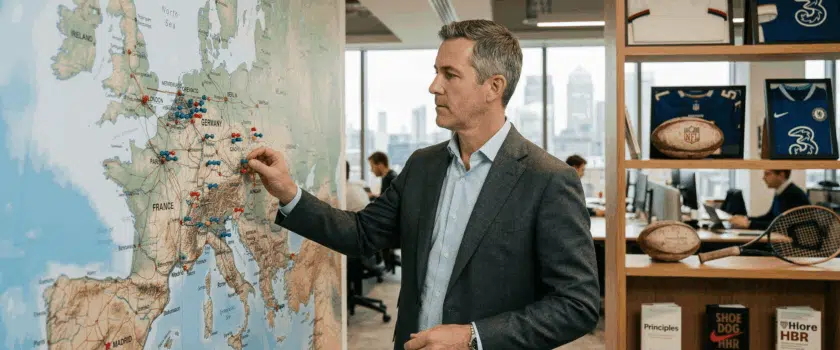
Why US sports companies struggle to hire in Europe
US sports brands are crossing the Atlantic faster than ever. Fanatics opened its London office. Overtime, DraftKings, and a wave of sports tech startups are all eyeing the continent as their next growth market. And yet, for every successful expansion, there are quietly shelved hiring plans, drawn-out recruitment processes, and positions that stayed open far longer than anyone expected.
The problem isn’t that European sports talent is hard to find. It’s that US companies often arrive with assumptions built for a market that works very differently from the one they’re entering.
Understanding where those assumptions break down is the first step to hiring effectively on this side of the Atlantic.
Misreading the european talent landscape
he most common mistake US sports brands make when hiring in Europe is treating “Europe” as a single market.
It isn’t.
A sports marketing professional in Paris operates in a world shaped by French labour law, French-language media, and a domestic sports culture dominated by football, rugby, and cycling. Their counterpart in Amsterdam may have an international mindset, strong English fluency, and expectations built around the Netherlands’ distinct employment framework. In Madrid, the talent pool is deep in football and padel, but English proficiency at senior level can vary significantly compared to Northern Europe.
US companies that post a single English-language job ad and expect pan-European applications to arrive are often disappointed. The most qualified candidates in France, Germany, or Spain aren’t necessarily browsing global job boards — they’re embedded in local professional networks, national sports federations, and regional industry events.
There’s also a structural difference in how sports careers are built in Europe versus the US. The American model — with its college sports pipeline, franchise-based leagues, and highly centralised media rights ecosystem — produces a specific kind of professional profile. European sports careers are more fragmented: across clubs, governing bodies, national federations, commercial rights holders, and a broad amateur sport infrastructure.
When a US company searches for a “Director of Partnerships” and expects someone with an NBA or NFL-adjacent background, they’ll find very few European equivalents — not because the talent doesn’t exist, but because the career path looks completely different.
Compensation, governance and cultural gaps
Salary expectations in the European sports industry don’t map cleanly onto US benchmarks — and neither do the contractual structures that surround them.
In the United States, total compensation packages built around variable pay, performance bonuses, and equity are standard at mid-to-senior level. In much of Europe, candidates expect a higher proportion of fixed salary, mandatory statutory benefits (paid leave entitlements, severance protections, employer social contributions), and clear terms governed by local labour law. An offer that looks competitive by US standards can read as underwhelming — or legally non-compliant — in Germany, France, or Spain.
European labour law in the sports sector adds real complexity. In France, the Convention collective nationale du sport (CCNS) governs employment across the sports industry and sets minimum pay grades, specific termination procedures, and rules around fixed-term contracts that most US HR teams have never encountered. Germany’s co-determination laws (Mitbestimmung) require companies of a certain size to involve workers’ councils in certain HR decisions. The UK, post-Brexit, operates its own employment law regime diverging from both the EU and the US.
Then there’s culture. European sports professionals — particularly those with experience in governing bodies or non-profit sport organisations — often place a high premium on purpose, autonomy, and work-life balance. A fast-moving US startup culture that expects employees to wear many hats, work across time zones, and stay always-on can feel like a poor fit to candidates used to more structured environments. This isn’t a dealbreaker, but it requires deliberate communication during the hiring process.
Governance expectations also differ. European sports is shaped by the UEFA model, the IOC framework, and national federation structures that emphasise integrity, multi-stakeholder governance, and institutional continuity. US companies arriving with a purely commercial, growth-at-all-costs mindset can encounter friction — both from candidates and from the institutions they want to work alongside.
How to structure local talent acquisition without a european HR team
For most US sports companies expanding into Europe, building a dedicated European HR function from day one isn’t feasible. But that doesn’t mean cross-border sports hiring has to be chaotic. A few practical structures make it manageable from the start.
Start with Employer of Record (EOR) solutions
An EOR acts as the legal employer on your behalf in a given country, handling payroll, tax compliance, and local labour law requirements while you manage the day-to-day work relationship. For a US sports brand hiring its first employees in France or Germany, an EOR removes the need to set up a local legal entity — which can take months and significant legal spend. Providers such as Deel, Remote, or Papaya Global operate across European markets and are well suited to this kind of early-stage setup.
Partner with local sports talent networks
Posting on LinkedIn or general job boards isn’t enough for senior or specialist roles in the sports industry. The European sports talent market is relationship-driven. Regional sports career platforms, national federation networks, and specialist recruiters with genuine industry access will get you to the right candidates faster than any broad-market search.
For companies looking to hire in Europe’s sports sector specifically, platforms with deep community ties — like SPORTYJOB — offer direct access to verified professionals across commercial, marketing, technical, and operational roles.
Localise your employer brand, not just your job ads
A careers page that references only US league partnerships, American athlete endorsements, and domestic market achievements won’t land with a candidate in Lyon or Lisbon. Invest in messaging that speaks to the European sports context — the competitions, the clubs, the structural realities — that your target hires actually care about. Localisation signals respect for the market you’re entering.
Build legal fluency before you need it
Before you make your first European hire, you need at least a working understanding of employment law in your target country. This doesn’t require a full legal team on day one. A single consultation with a local employment lawyer — covering contract standards, probation rules, notice periods, and social charges — can prevent expensive mistakes later.
Making european expansion work long-term
US sports companies that succeed in European hiring tend to share one trait: they treat the continent as a distinct market requiring genuine local knowledge, not a scaled-down version of their domestic playbook.
That means investing in local partnerships before you need to hire, building employer brand credibility within European sports ecosystems, and taking compliance seriously from the very first offer letter. The depth of sports expertise across football, cycling, athletics, motorsport, and emerging disciplines in Europe is genuinely world-class. The companies that access it are the ones that arrive with preparation and curiosity — not just a budget and a job description.
Expanding from the US into Europe? SPORTYJOB helps international sports organisations build a compliant and competitive hiring structure in the European sports market — from sourcing the right candidates to understanding the talent landscape behind each role. Explore open roles and post your positions on SPORTYJOB — Europe’s leading career platform for sports professionals.
Share
Facebook
X
LinkedIn
Telegram
Tumblr
Whatsapp
VK
Bluesky
Threads
Mail