
What Amer Sports’ product breakthroughs tell you about working there
The most revealing thing about a company’s internal culture is not what it says about itself, it’s what it builds.
Amer Sports has produced two of the most technically ambitious products in the outdoor industry in recent years: the Arc’teryx MO/GO, the world’s first powered hiking pants, and the Salomon Brigade INDEX, the first fully recyclable ski helmet. Neither of these arrived overnight. Both required years of cross-disciplinary work, external partnerships, and a willingness to discard decades of existing assumptions about what a product can or should be.
That process is the culture. And for anyone considering joining the group, it’s worth understanding exactly what it involved.
The MO/GO: four years of collaboration between apparel designers, roboticists, and AI engineers
Arc’teryx began conversations with Skip, a wearable robotics startup that spun out of Google X in 2023, in 2020. The partnership took four years to produce a product. That timeline is not a failure of efficiency. It reflects the actual complexity of what the teams were attempting.
The challenge was not just building a powered exoskeleton. It was building one that could be integrated into a functioning outdoor garment without compromising breathability, mobility, or the field durability that Arc’teryx’s reputation is built on. The solution involved carbon fibre cuffs worn inside a modified version of the Gamma Pant, chosen specifically for its softshell stretch and abrasion resistance, with battery-powered motors that snap onto the outside of each leg.
The system delivers a 40% boost to leg muscles on ascents and actively supports the knees on descents, while a built-in computer module reads sensor data in real time and anticipates the wearer’s movement rather than simply reacting to it. The product was named after the mountain goat, an animal that navigates steep terrain with a precision no human can match, and designed to make that kind of movement accessible to people whose mobility has been limited by age, injury, or fatigue.
The development process started with interviews. Arc’teryx and Skip spoke to hundreds of potential users before settling on the knee as the primary focus. They heard repeatedly that people could manage flat ground but struggled with elevation. The design followed the problem, not the other way round. Arc’teryx’s Advanced Concepts team, a dedicated group of scientists, engineers, and designers focused explicitly on pushing beyond the brand’s existing capabilities, drove the product from concept to prototype. The result was named one of TIME’s 200 Best Inventions of 2024.
What this tells you about working at Arc’teryx: the organisation has the appetite and the infrastructure to pursue projects that won’t produce a product for four years. The Advanced Concepts team exists specifically to create space for that kind of work. If you join as an engineer, materials scientist, or product developer, you are likely to work alongside people from disciplines that have never historically been part of outdoor apparel, robotics, AI, biomedical engineering.
The Brigade INDEX: five years to redesign a helmet from scratch using a single material
The Salomon Brigade INDEX started with a problem that had been ignored for decades: ski helmets are almost impossible to recycle.
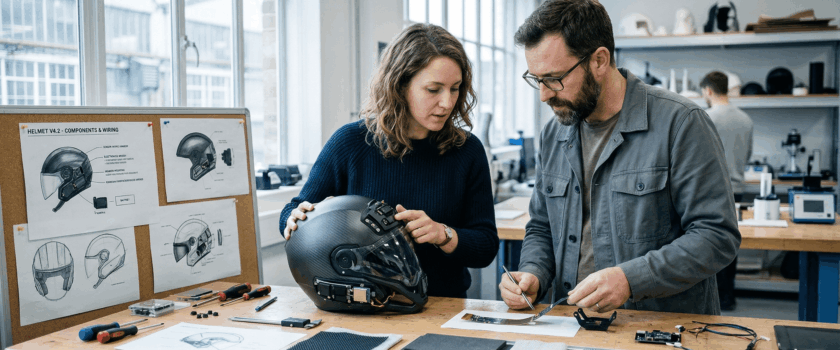
A conventional ski helmet mixes so many different materials, shell, core, straps, buckles, interior padding, that separating them at end of life is not economically viable. Most helmets end up incinerated or in landfill. Salomon’s winter sports team identified this in 2019 and spent the next four years working out whether it was possible to build a helmet from a single material family without compromising protection, fit, or comfort.
The answer turned out to be polypropylene. By redesigning every component of the helmet using materials from the polyolefin family, the team was able to produce a helmet that meets full CE safety certification and can be ground down and recycled entirely at end of life, without any disassembly, by recycling partner Paprec. The process required replacing every rivet, strap connector, and internal component with polypropylene equivalents, and then validating that none of those substitutions created a performance gap. Ski schools were brought in to stress-test prototypes under conditions of heavy daily use.
The Brigade INDEX reduces overall environmental impact by 19% compared to a standard Brigade helmet. When a customer is done with it, they send it back to Salomon free of charge. It becomes flowerpots, car bumpers, or crates, and the material cycle continues.
What this tells you about working at Salomon: the team that built the Brigade INDEX spent five years dismantling 22 years of accumulated materials knowledge and rebuilding it around a single constraint. That kind of project requires technical expertise across polymer chemistry, safety engineering, and supply chain design, but it also requires the organisational patience to pursue something that has no guaranteed outcome. Salomon’s R&D team was given that patience.
The work that doesn’t make the headlines
Both products took years to reach market. In the time between idea and launch, the innovation at Amer Sports happened in less visible places.
Global SAP rollouts coordinating systems across 40 countries. Life-cycle analysis frameworks applied to every major product category to quantify environmental impact at each stage of production. Supply chain teams building reverse logistics infrastructure that allows helmets to be returned, recycled, and reintroduced as raw material. Partnerships with organisations like Carbios, which helped Salomon develop the world’s first 100% fibre-to-fibre biorecycled T-shirt, that required sustained legal, technical, and commercial negotiation before a single product could be made.
These are not glamorous workstreams. They are also not optional. The innovations that reach the consumer are only possible because the infrastructure behind them works. At Amer Sports, that infrastructure is built and maintained by people in IT, finance, operations, legal, and sustainability, none of whom appear in a product launch video.
What this means for a potential hire
Amer Sports describes the culture it is looking for in functional but accurate terms: people with a creative mindset who find new ways to solve complex problems. The products above are not marketing language for that description. They are what it actually looks like in practice.
The MO/GO required a team that could bridge the gap between consumer outdoor apparel and medical-grade wearable robotics, two fields with almost no historical overlap. The Brigade INDEX required a team willing to discard 22 years of materials knowledge and start from a constraint, not a brief. Both required organisations that could sustain multi-year projects with uncertain outcomes and bring in external partners at exactly the right point.
If that kind of environment is where you do your best work, whether you come from product, engineering, sustainability, operations, or IT, the open roles at Amer Sports across Arc’teryx, Salomon, Wilson, Atomic, and Peak Performance are worth exploring in detail.
Browse all open positions across the Amer Sports group directly on SPORTYJOB!
SPORTYJOB is the go-to platform for careers in the sports, outdoor, and lifestyle industries in Europe. New roles added regularly, set up your profile and be among the first to apply.
Share
Facebook
X
LinkedIn
Telegram
Tumblr
Whatsapp
VK
Bluesky
Threads
Mail