
INSIDERS x Sébastien Béquart
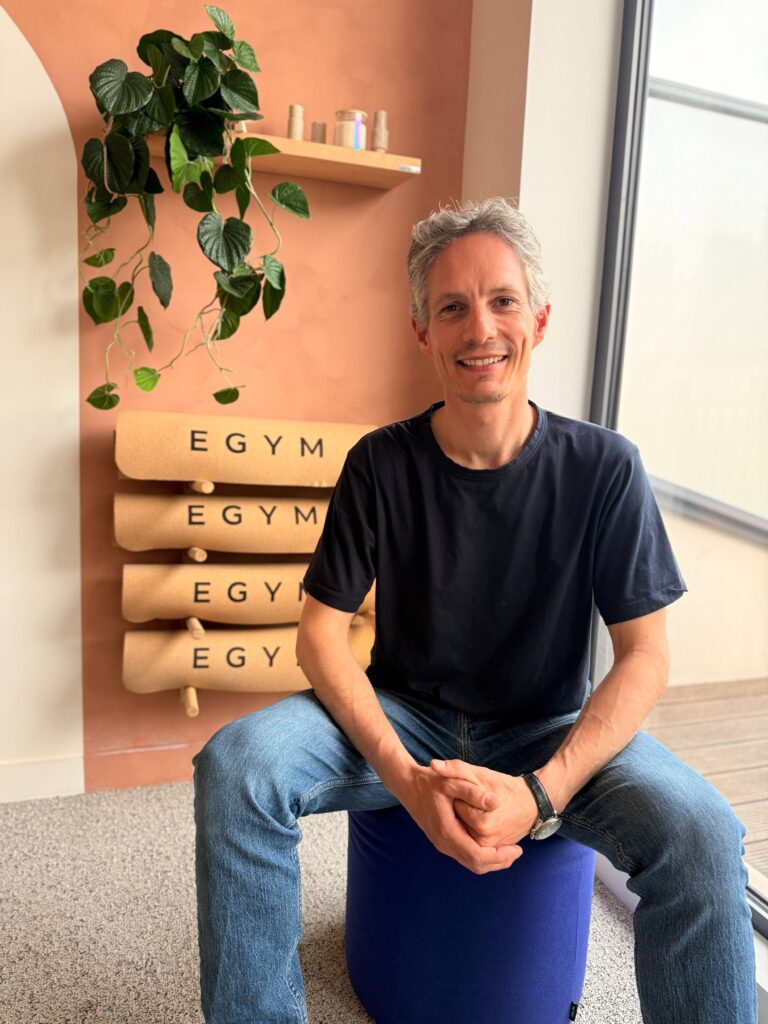
CEO & co-founder Egym Wellpass
The wellness and corporate sports subscription market is dynamically evolving as companies increasingly recognize the power of sport in enhancing employee motivation and health. In this shifting landscape, Egym Wellpass stands out as a transformative leader. Born from the fusion of French startup Jimlib and the German Yigim, Egym Wellpass has revolutionized access to sporting activities for corporate employees across Europe, boasting nearly a million eligible users and partnerships with 2,000 companies.
The recent strategic merger with the PLAYLIST group, merging Egym Wellpass with strong B2C players in the US and Europe, signals a bold step in expanding its footprint and innovation capacity. Today, we have the privilege to dive deep with Sébastien Béquart, the Country Manager France & VP Partner Management at Egym Wellpass.
Sébastien not only oversees the French market but also spearheads partner relations across Europe, driving the mission to cultivate active lifestyles through accessible, incentivized fitness options at work.
INSIDERS with Sébastien Béquart, let’s dive into another fascinating interview!
Hi Sébastien, great to chat with you, thanks so much for taking the time! Could you start by introducing yourself and telling us a bit about your current role?
Sure! I’m Sébastien Béquart, one of the co-founders of Gymlib, a startup we created in 2013 with the mission to simplify access to sports facilities. It’s been a long journey , from 2013 to 2022, when we merged with a German player called Egym.
To quickly recap: Gymlib was initially B2C, with the idea of selling short-term access to gyms at reduced prices. After a few years, we made a double pivot. First, a product pivot , moving from short-term access to a single subscription giving access to thousands of sports facilities. Second, a distribution pivot , we realised that the corporate B2B space was the perfect place to address the main barrier to physical activity, which is motivation, not cost. In the workplace, you have so many people who can help employees stay active. So we became a 100% B2B company.
Today, our mission at Egym Wellpass , what Gymlib became after the merger , is to engage companies and their employees in an active lifestyle. We do that through a single subscription that gives access to thousands of sports facilities: gyms, climbing walls, five-a-side football, padel, tennis, and more. The financial model is similar to meal vouchers , companies co-finance the access so employees get it at a very competitive rate. We currently work with around 2,000 corporate clients, nearly one million eligible employees, and a team of 100 people in France.
As for my role: since the 2022 merger with a group present in Germany, the UK, and now the US, I’m both responsible for France and for a broader remit covering partner relations , gym partnerships and so on. And this is actually a timely interview because we’re now merging with our historic competitor, Classpass, which is part of the Playlist group , which also includes Mindbody. On paper, it’s a great fit: they’re strong in B2C and in the US, while we’re strong in B2B and very established in Europe.
What about the integration, are you already working together, sharing offices?
I should clarify: the deal was signed in January, but the closing hasn’t happened yet , it will in the coming months. At this stage, I genuinely don’t know how things will be organised, but the most likely scenario is that both companies continue to operate independently for now, without immediate structural changes.
If we zoom out , how do you see the sport-health industry today? What are the big trends, the challenges, the opportunities?
A few things stand out to me. First, we’re now a year and a half post the Paris Olympics, and 2024 was a real boost for a lot of sports startups. But the year that follows is always harder , you’ve structured up for more business, and then you have to manage the slowdown in a broader economic context that’s been pretty tough.
Looking at what’s happening in the space, AI is a big one. What I see it doing is twofold: first, using AI in service of prevention and behaviour change , raising awareness around healthy habits, which is powerful because it addresses things upstream. Second, AI is enabling much better monitoring, data analysis, and performance insights, which is very valuable for corporate wellness programmes.
I’m also seeing a lot of startups building around digitalised health plans , the concept of determining your “bio-age”, your biological age. The idea is that through a battery of tests , both questionnaires and physical assessments , you can find out your actual biological age versus your chronological age, and then work to improve it. There’s a lot of interest in longevity in that space.
Mental health is a trend too, though it’s been around for a few years now. What’s interesting is that many of the players entering that market are pointing to physical activity as one of the core solutions , so it’s still very connected to what we do.
And then there are two very strong trends that are really illustrated by the rise of Strava , though Strava is just one example. The first is that people now want to measure their performance. The second is that they want to share it with a community. I belong to a running tribe, a cycling tribe. I was struck recently when we went for a team run and people were saying, “We’re not running for free” , meaning, we need to be on Strava before we start. That’s how embedded it’s become.
You mentioned bio-age, can Egym's machines actually measure that?
Yes, exactly , and that’s a good transition to the Egym Technology side of the business, because Egym has two branches: Egym Wellpass, which is what I do, and Egym Technology, which sells the machines. These are genuinely revolutionary pieces of equipment , they can measure your biological age and help you work on improving it. There’s a lot of gamification built in, which makes the experience more engaging and enjoyable. What we see in gyms that have these machines is how meaningful it is for users to do a Day 1 health assessment and then track their progress over time.
What are the main challenges and priorities for Egym Wellpass in the coming period?
The first big one is unlocking the synergies from the Playlist merger. On paper, we’re very complementary , they’re strong in B2C and the US, we’re strong in B2B and Europe. The question is how we accelerate each other’s growth and how we realise that business potential together.
The second is something we’ve wanted to do for a long time, and I think the timing is finally right: building genuine partnerships with health insurers , mutuelles and complémentaires santé. Our mission is ultimately about shifting the healthcare system from a cure model to a prevention model. We know you can’t reduce healthcare costs in one year of sport , but over the long term, the logic is undeniable.
We have the data, we have the engagement, we have long-standing corporate clients like PwC and KPMG where Gymlib/Wellpass activation has been very strong for seven or eight years. Imagine being able to show that healthcare costs have measurably decreased for those populations. That would be extraordinary. We’re actively recruiting someone who will be 100% dedicated to building those insurer partnerships , and I’m hoping we’ll launch a first pilot within 12 months.
What about the internal team challenges, culture, structure, growth?
The merge with Playlist will be a major one mentally too , learning from their best practices, absorbing their culture. That will be exciting. And then there’s the classic challenge of scaling while keeping your culture intact. We’ve just passed 100 people in France for Wellpass. How do you stay agile at 100+? How do you keep the culture you love when you can no longer know everyone personally? That’s a real, beautiful challenge.
What makes Egym Wellpass's culture distinctive?
I’d say three things. First, the mission, it’s genuinely meaningful. We hear from clients whose lives have been changed. That’s not hyperbole. And we’re lucky to have a mission like that. Second, we’re a young, dynamic, ambitious structure , there’s real pressure and real stakes, which is stimulating. The mission is exciting and there’s urgency to deliver on it. Third, and this is the strongest one: we’ve built a culture of genuine care for the employee experience. We merged with a German group that shares those values , which made the integration feel natural.
Concretely, that means: quality management, welcoming offices, real flexibility to integrate sport into the workday , lockers, showers, and a culture where it’s not just tolerated but genuinely encouraged. It also means a hybrid setup: on average two days remote, three in the office. When people are in, there’s real energy and a lot of informal exchanges. Our offices are designed for that , meeting rooms, one-on-one spaces, an entire floor without desks dedicated to informal interaction.
And the turnover reflects that?
It’s below average, yes. Like everyone, we’ve had waves , there was a post-Covid wave , but overall, retention has been solid.
For people outside the company, how would you describe a typical day at Egym Wellpass?
I don’t want to overdo the sport angle, but it’s real: we genuinely try to make it easy to integrate sport into your working routine. Not just through infrastructure , lockers, showers , but through the culture around it. Going for a run at lunch is not just accepted, it’s valued. Beyond that, it’s a team of highly engaged people who communicate a lot, partly because we’re hybrid. The remote days are focused , heads-down work. The office days are social, exchanges, informal moments, spontaneous collaborations. That rhythm works really well.
What inspired you to create Gymlib in the first place?
It started with a meeting, I co-founded it with Mohamed Tazi, whom I met at Deloitte. But it wasn’t just the encounter. I’d had the desire to start something for a long time, even when I was at Deloitte. It wasn’t urgent, but it was always there. When the right person and the right idea came together, it clicked. I had always told myself I would only start a company when I had full trust in the person I was doing it with, and I did.
I should also say: the first three or four years were genuinely hard. What made Gymlib a success was a third co-founder who came in later, Grégoire Véron: he wasn’t there from day one, but his impact was absolutely decisive. I say that sincerely. Without him, I genuinely don’t think we’d have made it as far as we did. He’s what I’d call a late co-founder, and that doesn’t make him any less of one.
What's the most structurally important decision you've made in your career?
Four, actually. First: joining Deloitte straight out of school. That’s where I met my wife, my co-founders, my closest friends. It was exceptional. Second: leaving Deloitte to start a company, despite the risks, despite the uncertainty, despite everyone asking “why would you leave when you’re doing so well?” I never regretted it for a second. Third: the double pivot at Gymlib, both the product pivot and the distribution pivot toward B2B. That decision is the foundation of everything that followed. It required real courage to persevere while also changing direction. And fourth: the merger with Egym, a competitor and a bigger player. In a way, it meant stepping back from full entrepreneurial control, the CEO of the group is the German CEO, not me. But what we gained is enormous: we went from a French startup to a company that’s part of an international group, where our teams work in international settings and we speak English every day. That transformation has been just as structuring as everything that came before.
Any final message for the audience: candidates, employers, anyone?
For aspiring entrepreneurs: launch with boldness. Whatever happens, it’ll be worth it: you’ll grow from it in ways you can’t anticipate. I would have regretted not doing it deeply. So go. Don’t over-calculate the risks. Just go.
For employers: don’t underestimate the responsibility you have to change people’s lives. The ability to truly support your team’s work-life balance, to create conditions where they can live actively, is fundamental. That’s not a nice-to-have. It’s one of the most important things you do.
Célia, Head of Sportstyle & Wellness at BOOST
Sign Up
Forgot Password
Cart
Your cart is currently empty.