
INSIDERS with Kevin Croq
Country Leader France & Benelux at Suunto
Today we’re diving into SUUNTO, the Finnish company and international leader in outdoor wearables. To explore the brand’s world, we sat down with Kevin Croq, recently promoted to Country Leader France & Benelux. We met Kevin in Amsterdam during The International Running Expo, where he was with part of his team.
Before you dive into the interview, fair warning: the conversation with Kevin was particularly rich and interesting. A super positive personality, an inspiring journey built on resilience and strong choices, and a deep attachment to his company driven by SUUNTO’s very particular culture (less but better!).
Over to Kevin, enjoy!
Hi Kevin! Great to chat with you at the SUUNTO booth during The International Running Expo here in Amsterdam. Can you explain your role as Country Leader and how SUUNTO is organized?
I’m Country Leader for France, Belgium and the Netherlands, what we call “the regions” at SUUNTO. We report to a Sales Manager who oversees all of Europe. It’s a really short, very direct organization.
My role is to be the guardian of the business across these three countries, in its entirety. And one particularity of SUUNTO is the very strong integration between sales and marketing teams. For example, the Marketing team is fully part of the team, even if I’m not their direct manager. We really work as a duo: we’re actually the two presenting the 2026 budget right now.
This transversal approach also exists globally. Our German, Spanish and other regional counterparts are as much our colleagues as those based in France. Every month, it’s not just one country reporting to a regional manager; we all share our progress, our issues, our best practices, and that creates real collective value.

"Every month, we all share our progress, our issues, our best practices. That creates real collective value."
Outdoor practices vary enormously between countries: trail, running, mountaineering... How does SUUNTO manage to maintain a global direction while staying locally relevant?
That’s exactly why we have real local freedom. We can adapt our commercial or marketing strategy as we wish, as long as it’s validated, obviously. But overall, we have real space to propose what’s most relevant for our market.
That’s also why we have few junior profiles: we need very autonomous people, capable of being advisory forces, capable of telling global “this won’t work like that for us” and adapting intelligently. Your management supports you, but ultimately you’re responsible for your market. So you need to be very proactive and mature enough to challenge, argue and implement the right things.
From a leadership perspective, it clearly requires professional maturity and a lot of autonomy.
What are SUUNTO's priority markets today, and what makes the French market special?
Today, Europe is the most important market in terms of weight. And France remains one of SUUNTO’s biggest markets globally.
France has a very strong particularity: the Alps. It’s a historic territory for us. SUUNTO has been established there for a long time, thanks to products designed for mountaineering and committed outdoor practices.
We’re also seeing really strong growth with specialists like IRUN, which went from 3 to 22 stores in six years. It’s a real example of a distributor structuring the market and pulling the category upward.
In North America, we were starting from further back, so growth is mechanically stronger: they’re opening new distribution channels, which creates an obvious acceleration effect.
France is said to be a very price-stable market. What does that change concretely for SUUNTO?
France is indeed a very price-stable market. We have real proximity with our retailers, which creates great trust and helps maintain that stability.
In electronics, price stability is a major issue. Some markets are much more volatile. Historically, some distributors there bet on volume rather than margin, and that model suffers a bit more today.
And it shows a simple reality: the more price-stable a market is, the more the business grows. When a market becomes chaotic, exploded, revenue always ends up declining.
So each market has its own logic and constraints.
We're seeing SUUNTO invest more in running. What are the stakes behind your new products and this rise in the segment?
Yes, we launched a new range, “Suunto Run,” because it’s really the market growing the most today. There’s a lot to do, both in terms of products and distribution. The market is evolving: running is no longer only addressed by run specialists. Now, consumer electronics retailers like Boulanger, Fnac and others are taking more and more space in the category.
For us, it’s a major growth lever. But the whole challenge is not to lose our outdoor DNA. Even as we develop running, SUUNTO remains a brand deeply rooted in outdoor and alpine practice. It’s important that the brand keeps that compass.
We’re also careful to diversify our segments, so we don’t put all our eggs in one basket. Running is becoming a growth engine, but we continue to invest in the rest of our categories.
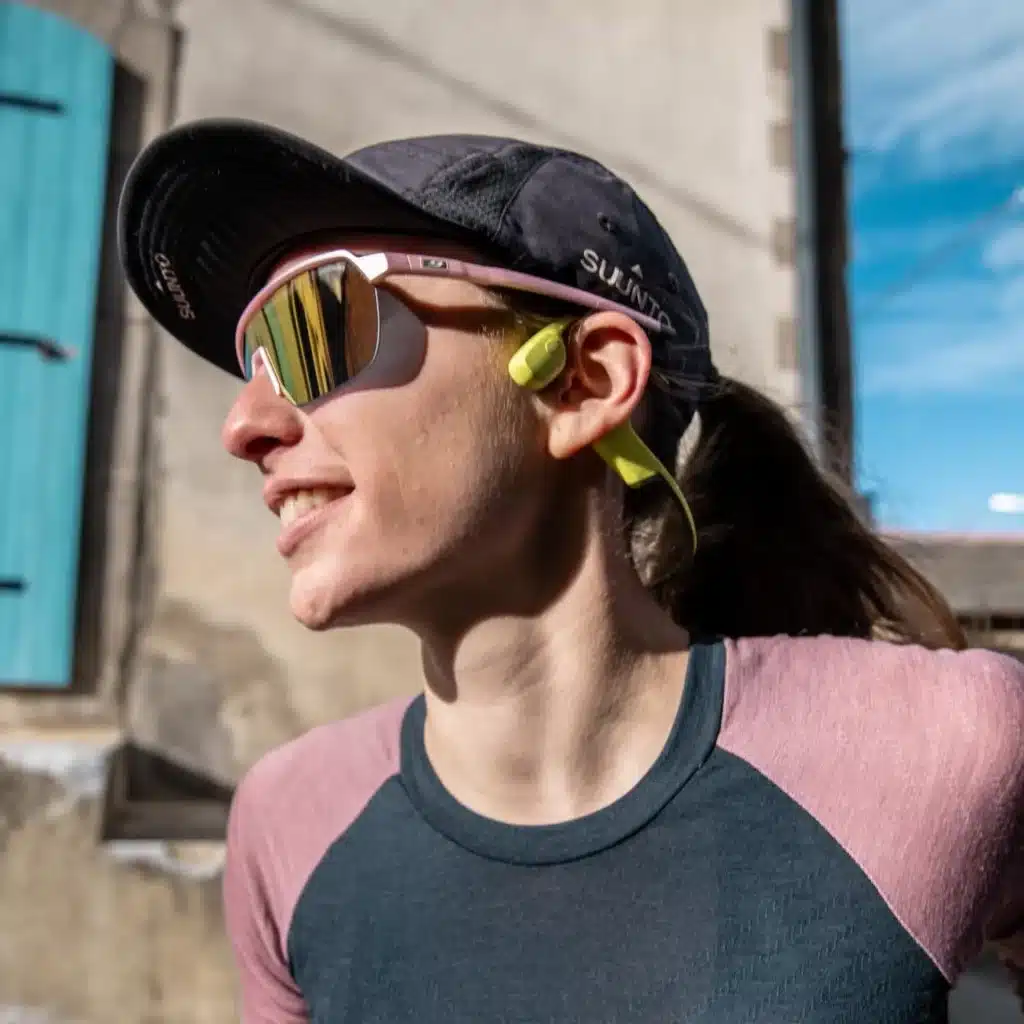
You also launched the "Suunto Sonic" bone conduction headphones. Why this diversification?
For us, entering this market made complete sense. A watch naturally connects to headphones, so there was a logical continuity between the two. And bone conduction is a technology that really makes sense in outdoor, because it allows you to hear your environment, which is essential in trail or mountains.
We wanted to add the “SUUNTO touch”: a power bank on some models, an integrated light for safety, head movement control, because it’s adapted to outdoor sports. The idea is to offer something that completes the SUUNTO ecosystem, without going into a domain too far removed.
It’s also a way to strengthen the relationship with our existing users: someone who already uses a SUUNTO watch can stay in the SUUNTO universe for their headphones. It really makes sense.
Unlike other brands, SUUNTO doesn't try to be everywhere. How would you describe your distribution strategy?
We really have a “less but better” strategy. We’re not in an expansionist logic where we need to be present everywhere, because that can have a negative impact on pricing strategy.
When we open an account, it’s for the long term. We want to make sure we’ll work in partnership and not just multiply points of sale. That’s why, on headphones for example, we’re not opening new distribution channels: we’re relying on our existing network.
It’s an assumed approach that protects the brand and our partners.
"We really have a 'less but better' strategy. We're not in an expansionist logic."
SUUNTO is known for its particular relationship between retail and e-commerce. How does that work?
E-commerce at SUUNTO is absolutely not a competitor. On the contrary, we really work hand in hand. We have a real omnichannel strategy.
E-commerce is a showcase: it gives a price reference, shows campaigns, provides a benchmark for the rest of the market. And there’s never been a case where e-commerce explodes while retail drops. Both progress together, which isn’t always the case with other brands.
What’s key is that SUUNTO never does product launches exclusively in e-commerce. Unlike some competitors who launch products only online and create frustration among their retailers, we maintain balance. We want to grow e-commerce, but not at the expense of the physical network.
Each market is addressed by a global e-commerce team, working with local specificities. It’s a very coherent system.
The "less but better" spirit seems at the heart of SUUNTO's culture. How would you describe that mindset?
Honestly, I feel really lucky to work for Suunto.
SUUNTO will celebrate its 90th anniversary next year, and it’s a brand that’s always kept its feet on the ground. It’s a historic company in Finland, a real cultural pillar. It’s pretty crazy when you think about it: we sell devices for navigation, and SUUNTO invented the liquid-filled portable compass 90 years ago. We’re still in the same universe.
It’s not a brand that seeks to grow too fast. We secure, we work with the right partners, we keep a very long-term approach. And even with products, we’re careful: not going too fast so we don’t lose our way.
We have the chance to choose our distribution network. It’s not “open everywhere” to make short-term revenue, but build solid, lasting relationships.
And then there’s the proximity to Helsinki. The marketing and R&D teams really know what’s happening in the field. Exchanges are direct, regular. That’s something very precious in an international brand.
To finish, let's talk about your journey. What were the choices, experiences or turning points that led you to your current role at SUUNTO?
Originally, I studied electronics and industrial computing. You might think I’m very far from my current job, but not really: there’s always been this link with technology, precision, product understanding. I’ve always been quite passionate about what I did, whatever the field.
After high school, I continued in this technical path, but I felt I didn’t want to become an electronics engineer. I wanted to go toward something else, something more complete. I joined a business school that offered a real dual technical and commercial skill set. The degree was “business engineer,” and it suited me perfectly: you keep a technical dimension while developing commercial skills.
I did all my studies through work-study programs, and I absolutely don’t regret that choice. It was a huge plus: three weeks per month in a company, you’re almost already in professional life. The company saves time on training, and for the student, it often allows getting a permanent contract in continuity.
I worked in echocardiography for an Italian group, specialized in ultrasound equipment distribution, mainly in cardiology and gynecology. I must have been 22 or 23 and found myself facing very experienced cardiologists. It was very technical, very demanding, but I loved it. Within months, I could do an echocardiogram myself, that technological side always appealed to me.
I’m from the 94 (Paris suburbs), studied in Toulon, then worked in Marseille. That’s where I met my wife, who’s from Auvergne. And as often with Auvergnats, there’s that famous call of the homeland… An opportunity came up in Auvergne, and I joined Electronica Technologies, where I was commercial manager of a branch specialized in measurement and control electronics, mainly linked to environment: flood alerts, highway weather, etc. Again, something very technical, in a completely different field.
It was fascinating, but public markets were too slow for me. I was 25 or 26 and needed movement. So I made a total reversal by joining a large international company specialized in printing and document management solutions. It was a very “shark” mentality, very formative and very hard. But I didn’t find myself in how it operated.
And then, there was an important event: at the time, I was doing speed motorcycle racing and had a very big crash. Since I couldn’t bike anymore because of an arm fracture, I started running. And living in Auvergne, I naturally went toward trail.
I’d also been diving since I was 16, which is amusing when you know where I work today. In the team, someone handles the diving part and we speak the same language.
It was in 2015 that I really wanted to link my passion to work. Trail was exploding and there was a small company in Auvergne growing fast: Oxsitis. I sent an unsolicited application and insisted. For six months. There was no open position, but I had a first interview, then a second with shareholders. I followed up, waited, pushed. When the position finally opened, I jumped.
It was a very field-based role, with tons of travel, lots of specialized retail. It meant a big salary cut for me, but I never regretted it. It was an incredible team, very human, highly involved. Oxsitis gave me back my appetite for work: colleagues you can count on, strong dynamics, lots of events… I stayed three and a half years.
And then SUUNTO arrived. I was headhunted through someone with whom the fit was immediate: Romain Berger, who works today at Salomon headquarters. He was looking for a profile for an opening and it matched right away. It was the most difficult change of my career, because I was very attached to Oxsitis. It was really a team of friends.
When I arrived at SUUNTO, the brand belonged to Amer Sports. Then I experienced the transition to Liesheng. It was a great opportunity and made us grow enormously.
Today, we’re in a group that perfectly understands electronics, totally respects the Finnish heritage and gives us a lot of latitude. It’s an enormous chance.
A final message?
Yes! SUUNTO is progressing strongly, so even if it’s not explicit today, there will definitely be opportunities in the coming months. Not just in France or Benelux, but throughout Europe. It’s the right time to get in touch with us.
Thanks for your time Kevin, it was a pleasure discovering SUUNTO's company culture through your journey and perspective, see you soon!
PE, co-CEO of BOOST, the purpose-driven HR consulting firm specializing in the sports industry
Sign Up
Forgot Password
Cart
Your cart is currently empty.