
INSIDERS with Eddy Ferhi
Head of Marketing France at ASICS
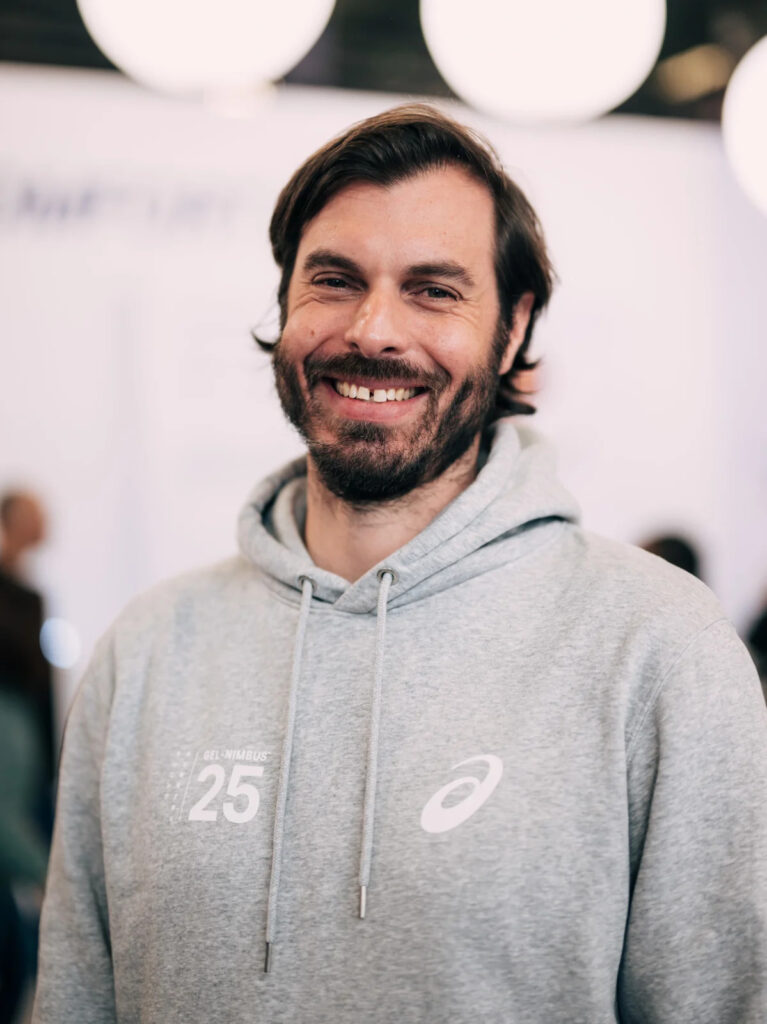
Eddy Ferhi’s path to Head of Marketing at ASICS France is anything but conventional. A former high-level ice hockey player turned sales professional, he built a career shaped by intellectual curiosity, a willingness to grow beyond comfort zones, and a deep respect for what it means to truly understand a market. In this INSIDERS conversation with Kenza Ligué, he opens up about ASICS’s brand DNA, its strategy in an increasingly competitive running landscape, and the competencies he believes will define the marketers of tomorrow.
Hi Eddy, really wonderful to have you on INSIDERS, thank you so much for making the time! To kick things off: your profile is pretty unusual. You've had a career as a high-level athlete, a significant stint in sales, and now you're Head of Marketing at ASICS France. What's the thread connecting all of that, if there even is one?
That’s a good question. I’m not sure there’s one single thread. If there is, it’s a continuous drive for learning, a refusal to reduce myself to just one thing, one discipline. I’ve always taken a lot of pleasure in waking up every morning fully passionate about what I do. As an athlete, when I felt (both physically and intellectually) that what I was looking for wasn’t quite there anymore, I have this trait where I go searching for new sources of growth and personal richness. I felt it was time to move on to something else. But I absolutely wanted to bring the same intensity to whatever came next. I didn’t want to wake up without that inner drive.
At the time, my passion was sneakers and sport: footwear, sport style. So I pursued that world. My ultimate goal was always to work for a sport brand, even if the path didn’t go there immediately. I eventually joined ASICS through a commercial, sport style route, not at all what I do today in marketing, but it was always the destination I had in mind. I worked across sneakers, sport style, and commercial functions, knowing those weren’t my final stop, but I needed that credibility before I could genuinely speak about marketing, which had always been my real passion. And today, I still try to find new things I haven’t mastered yet. That’s what continues to drive me.
Of course, happy to be here.
There's something very clear in what you're describing: the need to be genuinely engaged with a subject, even if it wasn't your original vocation, and this thread of curiosity. Once you're in a topic, you want to master it, to be credible on it.
Exactly. And I often connect it to my athletic career. In sport, you’re sometimes forced to work on things you don’t enjoy, developing skills that don’t come naturally to you. You play matches on your strengths; that’s what matters. But training and preparation force you to accept doing things that are less natural, because they’re what make you ready for match day. I think I’ve transferred that logic into my professional life. I don’t hesitate to take on things that might seem surprising or not obviously aligned with my passions, if they consolidate the foundation for what I really want to build.
Before we get into the market, can you clarify your exact scope at ASICS today?
Of course. I’m Head of Marketing, which means I oversee all of ASICS France’s marketing activities. To be precise: product and merchandising are handled by dedicated teams and sit outside my scope. Everything else is mine: communication, strategy, point-of-sale, consumer activation, media, and so on.
In terms of categories, we cover running. In France, we make a deliberate effort to treat road running and trail running as two distinct disciplines, almost two different categories. The consumer expectations, culture, and codes are fundamentally different, so applying the same playbook to both simply doesn’t work. Beyond running, we cover padel, tennis, and handball. Padel is a particularly exciting emerging category right now: it’s growing faster than its current revenue share might suggest, and it’s taking up more and more space in our discussions. And more recently, sport style has been fully added to my scope as well, as that division has taken on enormous weight within ASICS.
With such a varied scope (high-performance sports on one side, lifestyle on the other) how do you maintain strong brand consistency? Do your sport style and performance teams work closely together?
There are things that happen naturally, and things we have to consciously build. On the natural side, we’ve put our brand DNA back at the center of everything we do, uniformly across both performance and lifestyle. The idea that movement is a vehicle for well-being, for daily life, not only for peak performance, animates both sides of what we do. That’s what “Anima Sana In Corpore Sano” has always meant. So there’s already a natural alignment built in.
On the intentional side, we work hard to communicate across teams. Even someone focused exclusively on trail needs to understand what’s happening in sport style, and vice versa. We try to align our calendars so we’re not speaking over each other with competing messages. We align on visual identity, tone of voice, all of it. Is it easy? No. Like any large brand, we operate somewhat in silos, and things don’t always transfer naturally from one team to another. But there’s genuine curiosity across the board: the performance people are interested in sport style, and the sport style team has deep respect for our performance roots. A lot of our team members are runners themselves, so they live the brand in all its forms. We also draw on expertise from other European markets and from the global organization to help keep things coherent.
Doesn't going so far into lifestyle risk diluting your credibility on the performance side? Or blurring the message?
It can. We’ve seen other brands get lost that way, seduced by the lifestyle opportunity and gradually drifting from their performance DNA. We try to learn from those examples. The clarity is there: sport style is a segment we’re investing in fully, seriously, the way ASICS does things. But the essential thing is that we remain a credible performance brand, and a leader in our core sports. Our success in sport style depends on that. The products that work in lifestyle today are almost always products that came from running or were inspired by it. People wear them because they know those shoes were engineered with an extremely high level of technical precision. We’re naturally transferring those performance codes into everyday wear.
So in our objectives, it’s very clearly stated and reinforced whenever necessary: none of this is compatible with pulling back our presence, investment, or interest in performance, and particularly in running, which is where our story (especially in France) was built.
ASICS says it isn't a trend brand, but the running market right now is extremely noisy and trendy. How do you navigate that when more and more brands are entering the space and activating heavily?
It’s the challenge that keeps us busy every day. We see a lot of beautiful, dynamic activations out there, mixing performance running with fashion, with events, with cultural moments. We watch it carefully, and at the same time we know it’s not exactly our lane. Not because we think it’s uninteresting, but because running, for us, is not a fashion phenomenon. We’ve been a running brand since we were founded. We genuinely believe that beneath all the hype, there’s a deep structural movement. And that’s what interests us. If things eventually settle to something less trend-driven and more grounded, we’ll still be there, as we always have been, rain or shine.
That said, we’re aware this cultural visibility matters, and that we need to reach new consumers who are drawn to these codes. So we go there, thoughtfully, intelligently, without ever abandoning our fundamentals. We will never mislead the consumer with a product designed around a trend. Our products are the result of serious research and engineering to give runners the best possible tool. And we will never do things that aren’t in line with what we deeply believe: that movement, sport, and physical activity (beyond what it does for the body or competitive achievement) is an important vehicle for values and well-being in today’s world.
"We're not a trend brand. We don't know how to be anything other than ourselves, and it turns out that today, that resonates more strongly than ever with the consumer of our time."
You mentioned road and trail as two genuinely distinct areas. Can you tell us more about your trail strategy? We crossed paths at the ASICS Saint-Lary event. What's the broader approach?
We found it essential to specialize our teams. Before, with a limited team and no dedicated trail expertise, we had a tendency to duplicate road codes, doing what we knew best and applying it across the board. Even so, ASICS has strong results in trail. Some people are genuinely surprised to hear we’re the number two or three brand in trail in France. But we weren’t satisfied with the quality of connection we were having with the expert trail community. So we specialized.
The approach is to position ourselves at a level that matches our legitimate credibility, which isn’t always obvious to the most expert consumers. ASICS was actually part of the first wave of trail in France. We were there at the very beginning, with the Trabuco, when trail wasn’t even really a defined practice. We drifted from that audience at some point, and now we need to reconnect. Not from zero: our products are known, and we’re still a reference for many runners. But there’s a reattachment to build with certain audiences, a re-credibilization.
Geographically, that means focusing on the alpine zones, places where technical trail with serious elevation gain is practiced. In other trail environments, we’re already well-positioned. And credibility with the expert trail segment is built through performance at major events. Winning UTMB (including first and second among men last year, and a women’s podium) is how you demonstrate that ASICS makes products capable of the highest level. That’s the conversation we’re working to reopen with the serious, expert trail runner who demands a lot from the brands they choose.
What about the Marathon de Paris? Strategically, what does that event represent for ASICS France?
Almost everything, honestly. It’s the centerpiece of our year, where we allocate a large majority of our road marketing budget to cut through. And it’s an event we’re incredibly proud to have been a partner of since 2009. That history says a lot about ASICS’s relationship with running. It goes back further than the current boom, further than Covid or any recent trend. We were there because we love running. We’re still there for the same reason.
But the event has changed dramatically. A few years ago, the Marathon de Paris was significant but didn’t capture the broader cultural attention it does today. Now it’s an entirely different beast: bibs are nearly impossible to get, the commitment levels of participants are extraordinary, and brands are everywhere. So we’ve gone from simply existing at the event to needing to genuinely emerge in a very crowded, very noisy environment. Even with our major partner position, our marketing rights, our privileged placement, it’s genuinely not easy to cut through. That’s the core challenge.
Your career started in marketing, then went through a period in sales, and then back to marketing. What does that sales experience actually give you as Head of Marketing?
It did me a lot of good, personally. When I first worked in marketing without any sales experience, I had this feeling (whether real or imagined) that every idea I put forward was met with “Sure, but you don’t know the field.” And the truth is: the ultimate goal for a brand is always commercial. We’re all here because the brand sells enough products to sustain what we do. Knowing concretely what that means, factoring it into every line of thinking, is something that grounds my reasoning and reinforces decisions. There’s no better marketing than marketing that engages and stimulates but also has a tangible impact on the brand’s ability to sell. Having gone through the sales process, knowing what that conversation looks like with a client when things aren’t moving, it made me more complete.
I have a sports metaphor for this: sales was like my strength and conditioning work. I didn’t always love the gym when I played ice hockey. But hockey is a contact sport, and when a physical confrontation happens, you’re grateful for that foundation. Sales was my conditioning, my physical base, that made me better at what I truly loved doing: playing the game. In marketing terms, making the real impact.
What competency will separate a good marketer from an excellent one in the years ahead?
Two things stand out for me. First: always knowing the “why” behind what you do. In our world, things move fast, we’re constantly busy, and it’s easy to lose sight of the purpose of an action. But asking yourself “What am I actually trying to achieve with this?” leads to much simpler decisions downstream. It’s a small pause that saves a lot of confusion later. That’s not a new or modern skill, but it helps enormously.
Second, and this one feels increasingly urgent: intellectual flexibility and adaptability. The market has never moved this fast. Consumer behavior, technology, competitive dynamics, everything is shifting constantly. We used to be able to say “I understand how this works” and operate on that model for a few years. That’s no longer possible. If you’re not in constant connection with reality on the ground, if you can’t recognize when something that worked brilliantly a year ago is now completely obsolete, you’ll fall behind. That quality of being attentive, curious, and adaptable is, I think, genuinely essential today.
It's interesting that you said curiosity, not passion. That's not usually the first thing people in sports marketing put forward.
Passion can actually be a weakness sometimes. We have plenty of passionate people at ASICS, thankfully. But when that passion isn’t channeled properly (when you start thinking that because you know this world deeply, your opinion should prevail over everyone else’s) you lose the perspective to step back and say “I’m one runner among many.” When you can manage it, passion is a real advantage. But I genuinely prefer someone who is curious about what others experience, who listens carefully even if they’re not personally a die-hard practitioner.
I came from hockey, not running. But I believe I’ve been able to truly understand the levers of this world, to the point where I’ve even become something of a runner myself, on and off. Whereas if I were doing the same job in hockey, I’d probably struggle to separate my own perspective from a real understanding of the consumer. Curiosity, for me, comes first. Passion for doing your job well: that one is absolutely indispensable.
One last thing: a message for SPORTYJOB's audience, which includes brands, agencies, sports properties, and professionals across the sports industry. Any specific collaborations, partnerships, or profiles you're actively looking for?
"Passion can actually be a weakness. When you're so close to a subject that your own opinion starts to prevail over everyone else's, you lose the perspective to step back. Curiosity, for me, comes first."
Nothing super specific comes to mind, and honestly, I try to respond to pretty much everything I receive, even if it’s not always possible given the volume. But the spirit of curiosity I’ve been talking about applies here too: just because we didn’t formulate a need ourselves doesn’t mean we won’t find a proposal genuinely compelling. So whoever reads this and thinks they have a product, a project, an initiative that connects with anything we’ve discussed: reach out. The reception will always be, at the very minimum, polite and genuinely curious. Don’t hesitate.
Sign Up
Forgot Password
Cart
Your cart is currently empty.