
INSIDERS with Dean Aaron Sievers
Community & Event Manager at CEP
The running gear market is evolving rapidly as brands push the boundaries between technology and performance. In this dynamic landscape, CEP stands out by bridging medical expertise with athletic innovation. Founded as a compression specialist within the MEDI Group, CEP recently transformed with a bold rebranding and launched an innovative running shoe that embodies their vision of becoming a true running brand. This evolution represents a significant shift, blending deep technical knowledge with community-focused marketing and event initiatives.
Today, we’re excited to welcome Dean Aaron Sievers, Community & Event Manager at CEP. With a unique background in both medical devices and sport, Dean drives CEP’s event strategy, from major marathons to interactive test-and-try experiences that bring CEP’s distinctive products to passionate runners worldwide.
INSIDERS with Dean Aaron Sievers, let’s dive into another fascinating interview!
Hi Dean! Great to chat with you! Can you introduce yourself and tell us about your current role at CEP?
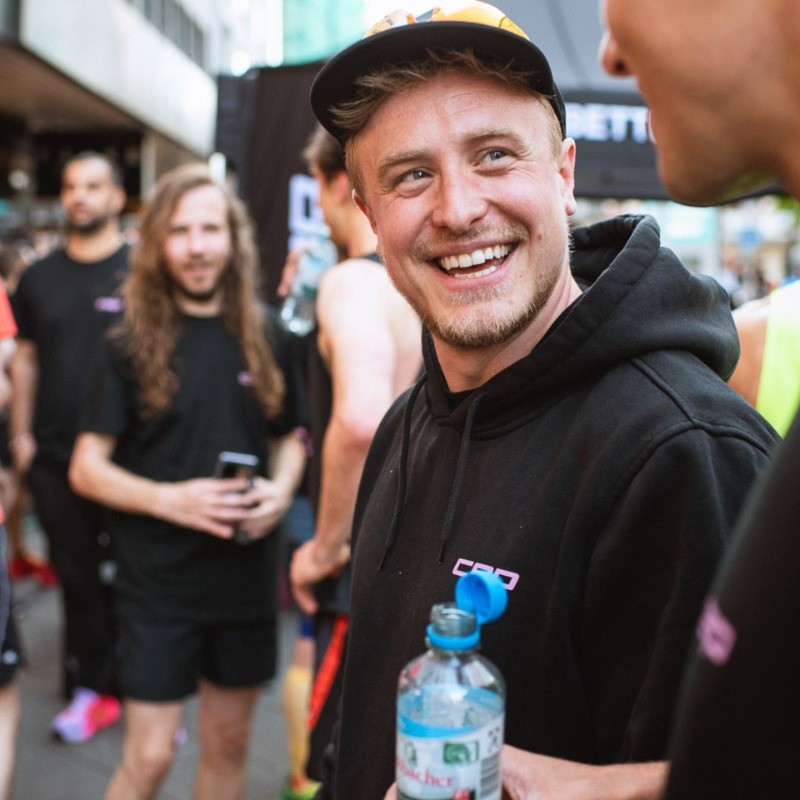
I’m the Community and Event Manager at CEP. I’ve been here for just about a year now — though I actually worked as a brand ambassador for CEP about six years ago as a student, so I already knew the company well. Before joining, I was working as an event manager at MEDI, the parent company, in the medical device space. When I was looking to move into the sports industry, I met with my now-boss Flo Weber, the Head of Marketing. He said he needed an event manager, and it was an easy decision — I already knew the brand. I came on board right in the middle of the big rebranding, so there was a lot of new ground to cover from day one.
Are there many people who make the switch from MEDI to CEP?
It’s not really a defined path, but it does happen. Sebastian, who you just spoke with, used to be a sales manager at MEDI before moving to CEP. I think it’s mostly a personal decision — people see there’s a sports brand in the group and feel drawn to it.
Does CEP feel like a more exciting place to be within the group?
It sometimes feels like a startup inside a bigger company — you get the adventure and excitement, but with the structure and backing of a larger group. That said, it cuts both ways: we’re not the main revenue driver compared to the medical side, so we don’t always get all the benefits that come with being the big company.
But we are more flexible in how we operate, and the team skews younger — which kind of comes with the product. What I find genuinely cool is that when we do something new — like launching the shoe — it creates a ripple effect back into the wider group. There’s a cultural shift happening, and CEP is feeding into that. It’s not us working against MEDI; it’s very much hand in hand. And we benefit a lot from having that infrastructure behind us.
To be clear about the structure: CEP is a brand of MEDI, not a standalone company. We share the same accounting, corporate services, HR, IT. CEP is essentially marketing, sales, product, and e-commerce. We have our own product and supply chain team, our own sales and marketing team, and our own digital and e-commerce team — but all the business services sit within the MEDI structure.
Can you walk us through your day-to-day scope within the company?
As Event Manager, my focus is primarily on the German market. I handle all B2C exhibitions — mostly the major marathon expos: Berlin Half Marathon, Berlin Marathon, Hamburg, Munich, Cologne, and Frankfurt.
At those events, we mainly book booth space and aim for premium positions. We’re not title sponsors — at Berlin, that’s Adidas; in Frankfurt, it’s Hoka. So we focus on making the most of our presence within the expo.
I also support B2B events like ISPO, acting as the bridge between sales and marketing. Beyond the big expos, I manage smaller marathon activations with retail partners — for example, in our hometown of Bayreuth, there’s a fun run where a local retailer sells our products and we send brand ambassadors to consult and support sales.
The third area — and the one I’m most focused on right now — is test-and-try events. Whether it’s with retailers, running communities, or other partners, I organize experiences where people can actually get into the shoe and run in it. Sometimes it’s a proper event with catering, music, and a photographer; sometimes it’s more community-driven. When it’s with a community, it’s primarily about content creation. When it’s with a retailer, it’s about driving sales and getting customers into the shoe. Either way, I work closely with our PR and social media team to make sure we’re capturing content and getting the right people there.
How many events does that add up to in a year?
This year it was probably around 35 to 40 events total — six major marathons, a number of smaller activations, and around 15 to 20 test-and-try events.
And even more planned for next year?
At least the same amount. But personally, I want to double down on test-and-try events. With our shoe especially, you can’t just explain the benefits — people need to actually run in it, ideally 5 to 10 kilometers, not five minutes on a treadmill. That’s where the product really speaks for itself. So that’s my priority going forward.
We’re also growing on the global side. I was involved in the Shanghai Marathon last week — not running it directly, but consulting: how we operate, how we present the brand at the booth, how we communicate the product. The ambition is to eventually have a presence at all the World Marathon Majors.
Will you be at the Paris Marathon?
Not Paris, I think. The focus right now is on Boston, New York, Sydney, Shanghai, Tokyo, and Berlin.
From a sales perspective, the marathon expos seem like big business, we saw Compressport and Decathlon doing massive volume over those two days.
Absolutely. The major marathon expos are clearly sales-driven. We try to layer in some brand building, but honestly, people aren’t there for that. They’re there for discounts, to pick up their race bib, to grab something. It’s a sales floor.
B2B fairs are a different story — they’re shifting more toward brand experience. We’re not writing orders with retailers on the spot at ISPO anymore. It’s about meetings, going on a morning run together, having conversations. The business gets done afterwards. You can see it in how brands approach their booths — some have nothing but a meeting table; others build out a full brand experience.
Can you tell us more about the rebranding CEP went through and the launch of the running footwear category?
To give some context: CEP started in 2007 as a compression company — compression socks first, then apparel and accessories. For years, even as we pushed into running, the market kept labeling us as a sock brand.
When the idea for a shoe came up, it triggered a deeper conversation about identity. We realized that if we wanted to launch a shoe, we couldn’t still be a sock company. And if we didn’t want to be a sock company, we needed the shoe. The launch became the catalyst for a full brand repositioning: we are now a running brand.
That doesn’t mean we’re abandoning our roots — compression is still our core expertise and a genuine differentiator, backed by decades of medical know-how. But now you can go head-to-toe in CEP: socks, apparel, and a shoe. Everything built with the same compression-informed philosophy.
The rebranding was also a chance to refresh the logo and the overall look and feel. There’s always a fear of change — retailers pushed back: ‘You’re so good at socks, why are you getting into shoes? It’s such a hard market.’ But that’s the spirit CEP has always had: take the technology from the medical world, apply it to sport, and do something that hasn’t been done before. We went for it.
"We couldn't still be a sock company. The shoe launch became the catalyst for a full brand repositioning: we are now a running brand."
What was the market reaction when you announced the shoe? The shelves aren't exactly empty when it comes to running shoes.
Mixed, to be honest. A lot of retailers were skeptical — they weren’t expecting it from us, and they weren’t wrong to ask why. There are so many shoes out there already.
But we genuinely believe we have something different. We’re also clear-eyed that this first model isn’t for everyone — not everyone will want to run in it, and that’s fine. What we’ve found is that the feedback is better than expected, but only when we put in the education work. The more we invest in helping retailers and customers understand the shoe, the better it lands.
Which is where your role comes in — the test-and-try events, the training of retail staff.
Exactly. And it goes across the whole company. Our e-commerce team needs great video content and clear explanations so that even someone buying online understands what they’re getting — including the medical insole, which can feel surprising if you’re not prepared for it. Then it flows through to the test-and-try events and the retailers.
Some retailers have been upfront and said they can’t sell this shoe — it takes too long to explain. That’s a fair point. Selling a carbon plate shoe is simpler: more cushioning, faster, take your pick. Our shoe requires a different conversation. But we’re working on expanding the range, and future models will be easier to position for a broader audience. It was an active decision to lead with something technically ambitious rather than an everyday trainer — it wouldn’t have been authentic to who CEP is.
So what is technically unique about the shoe, and who is it made for?
The core USP is the insole — a patented technology from MEDI called the Bowtech, originally developed as a footwear orthotic to address flat foot and support the natural landing mechanics of the foot. We built the shoe around it, just like we built our compression socks around MEDI’s compression technology.
The Bowtech supports the arch, prevents overpronation, and — interestingly — delivers energy return comparable to a carbon plate. But unlike a carbon plate, it works across all running gaits. Heel strikers can run in it safely; in fact, our testing showed heel strikers get the highest energy return due to the geometry of the plate. There’s none of the injury risk you sometimes get with carbon plates at slower paces or suboptimal form.
In terms of who it’s made for: the shoe performs best at faster paces — around 4:00 to 4:30 per kilometer is where our testers felt the biggest benefit. It’s not a race shoe, because the dual-plate construction isn’t legal for official race times. It’s a super trainer — built for long, fast training runs and intervals. The target runner is someone ambitious, chasing performance, looking to train hard.
That said, we also see a second profile: runners with a history of knee injuries or older runners whose joints need more support. The medical insole genuinely helps them run without pain — combined with the EVA foam in the heel, there’s solid cushioning for easier days too. So the range is broader than it might first appear.
From a distribution standpoint, that positioning sounds like running specialty stores rather than mass market.
For now, yes. In Germany we started with a select group of running specialists — not because we think we’re too exclusive, but because the shoe needs knowledgeable staff who can read a gait, explain the technology, and match the right customer to the product. Mass market comes later, with different models. This first shoe needed to be in the hands of people who could do it justice.
What are the major challenges ahead for CEP?
The big picture vision is to become a major running brand — not necessarily Adidas or Nike overnight, but a real, recognized player in the space. The challenge to get there isn’t really about product or positioning — I think the rebranding work the team did is genuinely strong.
The harder challenge is internal: healthy growth. We’re around 50 people at headquarters, covering Germany, Austria, and Switzerland as key markets. If you want to be a serious global brand, you need more people — and the right people. Growing the team in a sustainable way, maintaining the culture, keeping production and operations aligned — that’s the real work.
And with the shoe specifically: it’s hard to sell, it requires patience, and we have to stay focused and not lose momentum when things are demanding. There’s no quick fix there. It’s just about keeping going.
What is it like working at CEP day-to-day? Does it feel different from MEDI?
Very different — and that’s not a criticism of either. MEDI has around 2,000 people just in Bayreuth. CEP has 50. At that scale, you can’t help but have a startup energy, even if we know perfectly well we’re not a startup.
Everybody in the team genuinely wants to be there. There’s a lot of young energy. And even the people who aren’t young in age are young in mindset — my boss understands how we operate and gives us room to own our areas. The hierarchies are flat in practice, not just in theory. If I think we should do something, I tell him, and he backs me. If someone comes to me with an idea, I don’t need to run it up the chain.
We communicate directly — pick up the phone, solve the problem, move on. It keeps things fast. And there’s a healthy culture of constructive disagreement: someone might push back, a decision gets made anyway, and then we evaluate honestly whether it worked. That openness is something I really value. It’s not always smooth, but that’s fine — that’s how you grow.
"The hierarchies are flat in practice, not just in theory. If I think we should do something, I tell him, and he backs me."
Last question: open mic to 30,000 sports industry professionals across Europe. What do you want to say?
First thing that comes to mind: love, peace, and happiness. Be nice to each other — that’s genuinely the foundation of everything.
Beyond that: I don’t see this industry as zero-sum. Yes, we have competitors in compression, and now in running footwear. But the running community is growing fast, and runners don’t wear one brand head-to-toe. If I see someone in a CEP shirt and Hoka shoes, I just say — nice shirt. That’s the spirit.
What I really want to do is build events where people connect — runners, creators, brands, communities. The events I love most are the ones where a creator brings their crew, someone else brings theirs, and people just come together and run. If you want to collaborate on something — a run, an event, a community activation — hit me up. Right now mostly in Germany, but let’s talk.
Thanks for your time Dean!
Sign Up
Forgot Password
Cart
Your cart is currently empty.