
Nick Sargent, President of Snowsports Industry America, has watched the North American snow sports business from the inside for years. We caught up with him at ISPO in Amsterdam.
Hi Nick, great to chat with you. To kick things off, let’s go through the market perspectives. How is the snow sports business looking in North America today?
Average is probably a safe way to put it. We didn’t have a lot of snow last year. The East had good snow, but the West had none, so the retail community isn’t very confident about this coming winter, and that makes everyone jittery. The business in the US is anchored between American Thanksgiving in November and Easter, so let’s say early April. Retailers already have the equipment, so now they’re waiting for Thanksgiving, which is three weeks away, and then for cold weather. At the moment, we’re in a holding pattern.
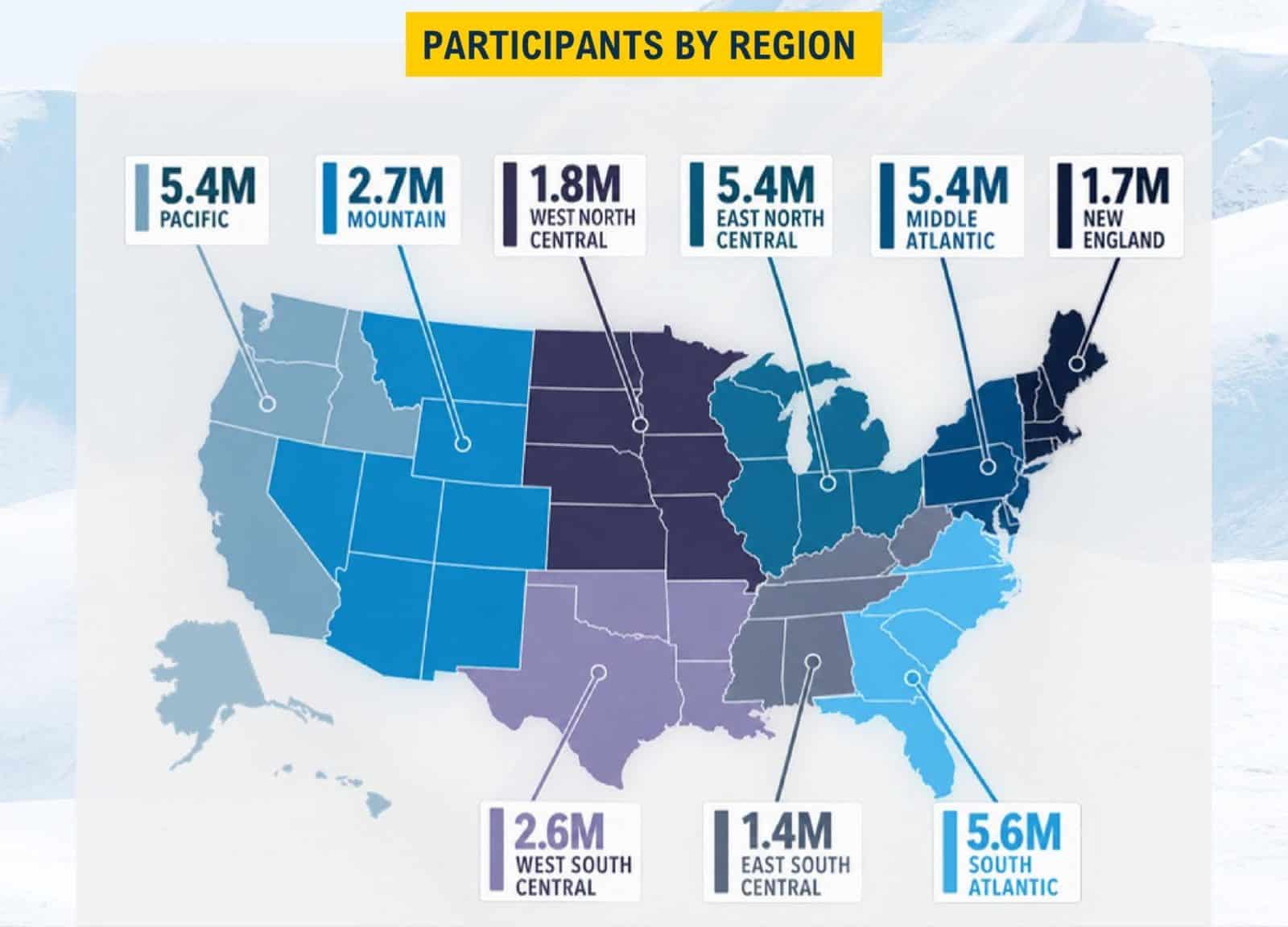
Source: SIA 2025-2026 Participation Study
What are the major trends you’re seeing?
The trends are about look and feel. How good are you going to look, and which products make you feel good and look good? On the technical side, you still have fat skis for powder, narrower skis for groomers, and everything in between. It’s whatever makes you comfortable and suits the snow. If your feet are uncomfortable, you won’t ski, no matter what skis you have. So getting the right boot, fitted to your foot, comes first. Then it’s about staying warm: your base layer, your apparel layering system, boot heaters, hand heaters. The technology for keeping you warm and dry keeps evolving. So for hard goods it’s really fit for ski boots, and for the upper body it’s warm and dry.
“People want affordability first”
Do you see the market moving toward a more premium price point, with upscale brands making their way in?
I think people look for the most affordable package. That could be a second-hand setup, or last year’s product that didn’t sell and that the retailer is clearing at a deep discount. People really don’t care about the graphic or the color. They want affordability first. You do have the 1% community that is driven by name brand, style and fashion, but they’re less concerned about staying warm and dry.
What is the impact of tariffs for your industry?
They will affect the early outcome of winter, especially for the consumer, who is waiting to see what happens. The manufacturer has bought the material, is building the product and shipping it, and now wants to get paid. If the consumer isn’t buying at retail, the retailer can’t pay the manufacturer. It’s a chain effect, and we’re waiting patiently to see how it unfolds. It really puts everything on hold and in the end, the final consumer will mostly bear all the tariffs, because manufacturers don’t have that much leverage. The retailer passes the increase on from the manufacturer, and the consumer is the end result. On the winter sports side, the consumer will say: “I bought these skis last year. I don’t need another pair, and I don’t need to spend an extra 10%, 15%, 20%. These skis are fine for two or three more years.” That pumps the brakes on the entire commerce side of the business.
“In the end, the final consumer will mostly bear all the tariffs, because manufacturers don’t have that much leverage.”
Are you already seeing bankruptcies among snow sports companies, as we’ve seen in cycling, for example?
We’ve seen some retailers close their doors and say, “We’re done, we’re not playing this game anymore.” We’ve seen some smaller manufacturers close because they can’t build product at a deficit. If there’s no path to profitability, it doesn’t make sense to move forward. Medium and larger brands are making internal operating-expense decisions to absorb the tariffs, so it will be some time before we see where the larger companies feel the weakness.
What are the differences between the North American and European snow sports industries? Are they massive?
Not necessarily. On the business side, you have your wholesale channel and your chain retailers. Wherever they live, consumers look for the best deal, whether that’s a sale or a closeout. That’s the same on both continents. In Europe, winter really runs from Christmas to Easter, whereas in the US it’s Thanksgiving to Easter, so we get an extra month of business. But we’re all waiting for the snow to fall, and snow is the real indicator. If it’s cold and wet, like it is now in Amsterdam, people start thinking about a new outer layer, a jacket, new boots, and they go out and buy them. It all starts in autumn. Then when they see snow, they think of skis, boots, bindings, snowboards, Nordic gear, sleds, whatever the medium. Snow really dictates when people start buying.
What do North Americans think of the European brands, like Salomon and Black Crows? They make up the majority of ski brands.
In the US, you have allegiance to specific brands, and you have allegiance to your wallet. It all comes down to price. If your favorite brand doesn’t have the right price, you go to the next brand and figure it out. At some point you have to decide between quality and how much you’re willing to spend. But European brands have always been popular in the US: Salomon, Atomic, the Amer brands, the Rossignol family with Dynastar. Then there are mid-tier and second-tier brands like Stöckli and Kästle. And then there are new brands like Van Deer, which is new to the US market and has a lot of cachet. I wouldn’t say many Americans know who Marcel Hirscher is, compared to Europeans. But the brand looks cool, the name is cool, and the association with Red Bull is cool. It’s also the most premium, expensive product on the ski wall, at 2,000 US dollars for a pair of skis.
Do you see opportunities for retailers and brands in the upcoming Winter Olympics?
Not really. It’s too early. The Olympics haven’t historically delivered new participants to winter sport. There’s no conversion. People get excited to watch, but they don’t get off the couch and say, “I want to learn skiing, and I’m going to buy a $2,000 pair of Van Deer skis, boots, bindings and jackets.” In the US, a lift ticket runs $300 to $350 a day. Add it up and that’s almost a $4,000 investment to go from the couch to the activity, and that has never translated. You do see people go out in the snow, make a snowball, maybe sled. That’s as close to the transition as it gets. The excitement of the Games is always great, and people get excited about competition and home-country nostalgia, but it doesn’t translate into getting on snow, skiing or riding.
“The Olympics haven’t historically delivered new participants to winter sport.”
Do you see a difference between the Games being held in Utah and now in France? Will that change anything for you?
I think it’s good for the Winter Games to be back in the Savoie, where they were in Albertville in 1992. I’ve been to a lot of Olympics, so I remember all those Games. It’s also good to be back in the American West, in the Wasatch, where the 2002 venues are being reused. I think the bigger story is the recycling of Olympic venues and the return to places with snow. There’s some Olympic fatigue from the Games held in Russia and Asia, where countries spent billions on venues that have never been used since. They’re deteriorating, and it feels very wasteful. I think the modern consumer recognizes that. There was a lot of negative press around Sarajevo, where the venues have all grown over and are covered in graffiti. They don’t represent a modern venue. But, as I said, the Olympics bring a lot of excitement, they bring nations together, and people love the sport element. It will be nice to be in France. I also thought Italy did a great job at the last Olympics and brought out the romance of the Games, with Tyrol and the rest. I think Grenoble will have the same effect.
We’ve also seen the reverse trend, with the Freeride World Tour arriving in Utah. I think it’s interesting that they’re branching out to both.
I think it’s interesting too. They have a lot of work to do to create a connection with the consumer. Most people don’t know the Freeride World Tour. They don’t understand the difference between a resort in France and one in the US, and they probably don’t understand the format or the judging. Freeride will be an Olympic sport in 2034, so we’ve got seven years to create excitement and education around it. I remember the Freeride World Tour at Snowbird, and I’m dating myself here, in the early to mid-90s. I was watching, and I thought, “This is cool,” then moved on to the next thing. But it’s exciting, and it’s good for the sport, good for the business and good for the consumer.
What are you looking for here at ISPO?
ISPO has a long heritage as the global gathering point for all winter sport. With new ownership and a new location, it’s hard to think of ISPO’s new home yet, but it’s a wonderful international community. The world has changed so much and will keep changing, and I think the winter outdoor community needs to embrace change. It needs to embrace the new and not be so negative about the past. We can’t advance the mission of growing our business if we’re stuck in yesterday. We have to look to tomorrow for new ways to innovate, operate, communicate and gather as an industry. I’ve always been a huge fan of Amsterdam. It’s a wonderful city and a great host for ISPO. I wish the new owners the best of business with ISPO, and I hope the larger winter sport community sees this as an opportunity and a gathering point. I brought my board here, and we’re holding our board meeting here on Wednesday. I have some European board members and some North American board members here to explore and see, which is great. We’re hoping for a good outcome.
“We can’t advance the mission of growing our business if we’re stuck in yesterday.”
One last question: you have an open mic to 35,000 people, what do you want to share with them?
Get outside! There’s a reason we’re here: we love sports. We love outdoor sports, we love winter sports. It’s disturbing when you hear the statistics on people who are on screens or on the couch and not getting outside. The keynote speaker of the Leaders Summit shared first data points on people who are outside, people who aren’t returning outside, and people who are staying inside. I think the figure was 45 minutes a day outside, moving. When you think about a 24-hour day, 45 minutes is so little. The benefits for health, spirit and mental well-being are endless. It’s painful. I’m guilty too, because I’m on this thing all the time, but that’s my job. I’m outside participating as much as I can. Being outside is such a wonderful way to live your life, and the health benefits outweigh anything on a screen or inside your house. So get outside!
Thank you, Nick.